Paperwork loses deals.
We kill the paperwork.
Cyberbase automates questionnaire and contract headaches,
so you can focus on what you do best – security

 DPAMSASubprocessors ListSOC 2 Type IISLAAccess Control PolicyTOS
From weeks to minutes
Today’s reality
Contract lands from prospect
50+ pages, urgent
Days to weeks
Deals stall. Competitors respond first.
with

Contract lands
50+ pages, urgent

Minutes, not weeks
Accurate. Sourced. Deal moves forward.
Trusted by security teams at companies like:


Send it. We'll handle it.
Questionnaires answered from your live security program. Contracts flagged and redlined in minutes. Free-forever AI Trust portal. You review the outcome, not the input.
Always current. Zero babysitting.
Cyberbase pulls from all your current policies automatically — every workflow starts from the same, up-to-date source of truth.
Outcomes, not dashboards.
Upload a headache-inducing document, get a win. Let AI do the dirty work so your day stays yours.


Turn your security program into a revenue accelerator
Your security program isn't a cost center. It's a closer
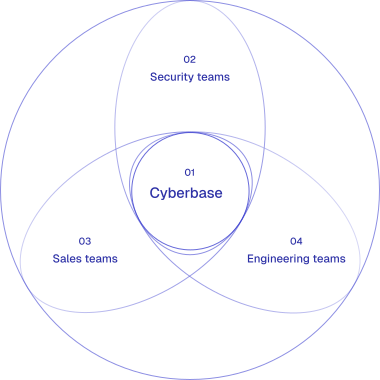
Built for seamless teamwork
Invite team members and ensure everyone works with the correct, up-to-date organizational security commitments.
See where security drives revenue
Understand which parts of your program are accelerating deals and where the opportunities are to move even faster — top-down and bottom-up.
Ready for any Сontract, any time
When a seven-figure deal lands mid-cycle, Cyberbase delivers a thorough response in minutes — keeping you on track and on the shortlist.
Enhances your existing workflows
Web agent pulls context from existing tools and pages — no API integrations to build, no migration project necessary.
Outcomes, not assistants
Cyberbase turns your team members into security heroes by giving them the tools they need to focus on what counts, not on the tedium that no one can spare the time to pore over in detail.
Accuracy you can depend on
We don't hallucinate. Your board won't forgive it if we did. Cyberbase was built from scratch to deliver defensible results that you can take straight to the boardroom, and then to the bank.


Built right by YSecurity
The on-demand cybersecurity team
Frequently asked questions
Does Cyberbase train on your data?
No. Cyberbase does not train AI models on customer data. Your security documentation, policies, and questionnaire responses remain completely private. We use your data solely to provide the service you've requested, never to improve our underlying models or for any other purpose.
Does Cyberbase provide indemnification?
Yes. Cyberbase provides indemnification for intellectual property claims related to our service. Enterprise customers receive comprehensive indemnification coverage as part of their agreement. Contact our sales team for specific terms and coverage details.
Can Cyberbase provide a single-tenant architecture for my organization?
Yes. Cyberbase AI offers single-tenant architecture for enterprise customers with strict data isolation requirements. Single-tenant deployments provide dedicated infrastructure, enhanced security controls, and complete data segregation. This option is available on our Enterprise plan.
Does Cyberbase have a SOC 2 Type II?
Yes. Cyberbase AI is SOC 2 Type II compliant. Our certification covers security, availability, and confidentiality trust service criteria. We undergo annual audits by an independent third-party auditor. Customers can request our SOC 2 Type II report through our security portal.
How does Cyberbase protect data?
Cyberbase protects data with enterprise-grade security controls. All data is encrypted at rest using AES-256 and in transit using TLS 1.3. We implement strict access controls, regular security audits, and continuous monitoring. Our infrastructure runs on SOC 2 compliant cloud providers with geographic redundancy.
What models does Cyberbase use, and who sees the data?
Cyberbase AI uses the Anthropic ISO 42001-certified models through their Commercial Terms of Service, which prohibit training and have strict data lifecycle management requirements, including data deletion and privacy requirements.
How many subprocessors does Cyberbase have?
Cyberbase AI maintains a minimal subprocessor list to reduce third-party risk. As per our Data Protection Addendum, Cyberbase AI only has 3 subprocessors, which include AWS, Google, and Anthropic. Cyberbase AI notifies customers of any subprocessor changes in advance per our data processing agreement.
What is contract redlining, and how does Cyberbase AI automate it?
Contract redlining is the work of going through and editing a legal document – a non-disclosure agreement, data processing addendum, or master services agreement, for example – to suggest revisions, point out potentially dangerous sections, and work out the conditions before it’s signed. Traditionally, redlining requires legal or compliance teams to read every page, cross-reference internal policies, and manually insert tracked changes — a process that can take days per contract. Cyberbase AI makes contract redlining automatic by using the playbook your business has already approved, the level of security it wants, and what the business needs to do to comply with the law, for any contract that comes in. The AI goes through the whole document, finds sections that are not what your business wants, and makes ‘track changes’ redlines in the usual DOCX file type – usually in less than 5 minutes for a contract of 100 pages. Your team then checks and agrees to what the AI has suggested, instead of beginning the work from the beginning, reducing the time for contract checking from days to minutes.
What is DDQ automation?
DDQ automation uses AI to complete due diligence questionnaires — the security, compliance, and operational questionnaires that vendors must answer during procurement, fundraising, and partnership evaluations. It usually takes teams ten to forty hours to finish a single DDQ by hand, as they must look through previous answers, policies, and paperwork proving compliance to respond to many questions. Cyberbase AI will fill in DDQ answers automatically by using Context Sphere to catalogue your business’s security guidelines, compliance approvals, prior questionnaire replies, and operational records. The AI will find the best source material for each question on a new DDQ and, in moments, create a correct answer which can be checked back to its origin. Excel files (.xlsx) and PDFs are among the supported types. This means responses that are prepared for an audit can be given in minutes, not days, and can be completely traced to the documents they came from.
How does Cyberbase automate security questionnaire responses?
Cyberbase AI automates security compliance questionnaire responses by constantly cataloguing your security policies, SOC 2 reports, compliance credentials, and previous questionnaire responses via its Context Sphere layer of knowledge. Upon your team getting a new security questionnaire or vendor evaluation, the AI links each query to the most relevant material from all your documents – and so makes correct, audit-suitable answers, with references to the sources. Unlike fixed, template-based programs, Cyberbase (security questionnaire software) remains up-to-date as your policies change and checks several sources to confirm uniformity. Where a query can’t be answered surely from current documentation, Cyberbase AI shows it as a possible policy deficiency and sends it to your security group for manual checking. Answers are given in moments, and Excel and PDF questionnaires are among the formats it supports.
What are the SOC 2 compliance requirements Cyberbase helps with?
To be SOC 2 compliant, companies must show they satisfy the AICPA’s Trust Services Criteria in five areas: security, availability, processing integrity, confidentiality, and privacy. This is done by keeping security policies written down, having access controls, using encryption, making sure there are ways to respond to security incidents, having a system for managing suppliers, and regularly checking everything – and then being able to show all of this in yearly audits. Cyberbase AI reduces the work of SOC 2 compliance in a couple of ways. It first handles answering the security questions and DDQs – detailed due diligence questionnaires – that potential and current clients and partners send when they’re checking you out as a supplier; these questions relate directly to how you’re doing on SOC 2. It also employs your SOC 2 paperwork, rules, and safeguards as part of its Context Sphere – a layer of knowledge – to guarantee that every contract change and questionnaire answer is truthful to what your compliance actually is. Cyberbase AI has SOC 2 Type II and ISO 42001 compliance.
What is ISO 42001, and why does it matter for AI compliance?
Published in 2023 by ISO/IEC, ISO 42001 is the international standard relating to Artificial Intelligence Management Systems – or AIMS. The standard gives companies that create, or have, AI a way to deal with the dangers linked to AI systems; it deals with how things are run, the quality of data, being open, lessening prejudice, and being responsible. Consider it as the ISO 27001 of information safety, but for AI. Cyberbase AI is ISO 42001 compliant, which means our AI systems — including the models that power contract redlining and DDQ automation — are governed by documented policies for responsible AI use, data handling, and quality assurance. For customers in regulated industries or those undergoing vendor security assessments, Cyberbase's compliance provides independent verification that our AI practices meet the highest international standards.
How does Cyberbase handle vendor security assessments?
Vendor security assessments: these are the questionnaires that potential business and partner clients issue to see if your company’s security and regulatory standards are good enough to work with, prior to any business being done. They usually ask about how you deal with data, your encryption, who has access to what, what happens if there’s a security issue, how your business carries on, and whether you’ve got accreditations – things like SOC 2 and ISO 27001. Cyberbase AI automates vendor security assessment responses by matching each question to relevant answers from your indexed security policies, compliance documentation, and previously completed assessments. The AI then creates correct, properly referenced answers, and points out any questions it isn’t sure about because your existing documents don’t give a definite answer. This gets the time it takes to reply down from days to minutes, and makes sure all the answers your team provides are the same, which is very important if lots of potential clients send in questionnaires that are almost, but not quite, identical.